Documentation Index

Fetch the complete documentation index at: https://docai.inclusioncloud.com/llms.txt

Use this file to discover all available pages before exploring further.

Configuring SAP Build Process Automation in SAP BTP

What you’ll learn

  • How to add SAP Build Process Automation entitlements to your SAP BTP subaccount
  • How to create a service instance and application subscription
  • How to review and verify entitlements, instances, and subscriptions
  • How to assign the required role collections to a business user
  • How to install the automation agent and activate Generative AI capabilities

Introduction

This guide walks you through the end-to-end setup of SAP Build Process Automation in an SAP Business Technology Platform (SAP BTP) environment. It is intended for SAP BTP administrators who need to configure entitlements, provision service instances, assign user roles, and prepare the environment for process automation projects.

Prerequisites

  • Administrator access to an SAP BTP global account and subaccount
  • A Cloud Foundry environment with a Dev space already created
  • A business user account to assign role collections to

Procedure 1: Adding entitlements for SAP Build Process Automation

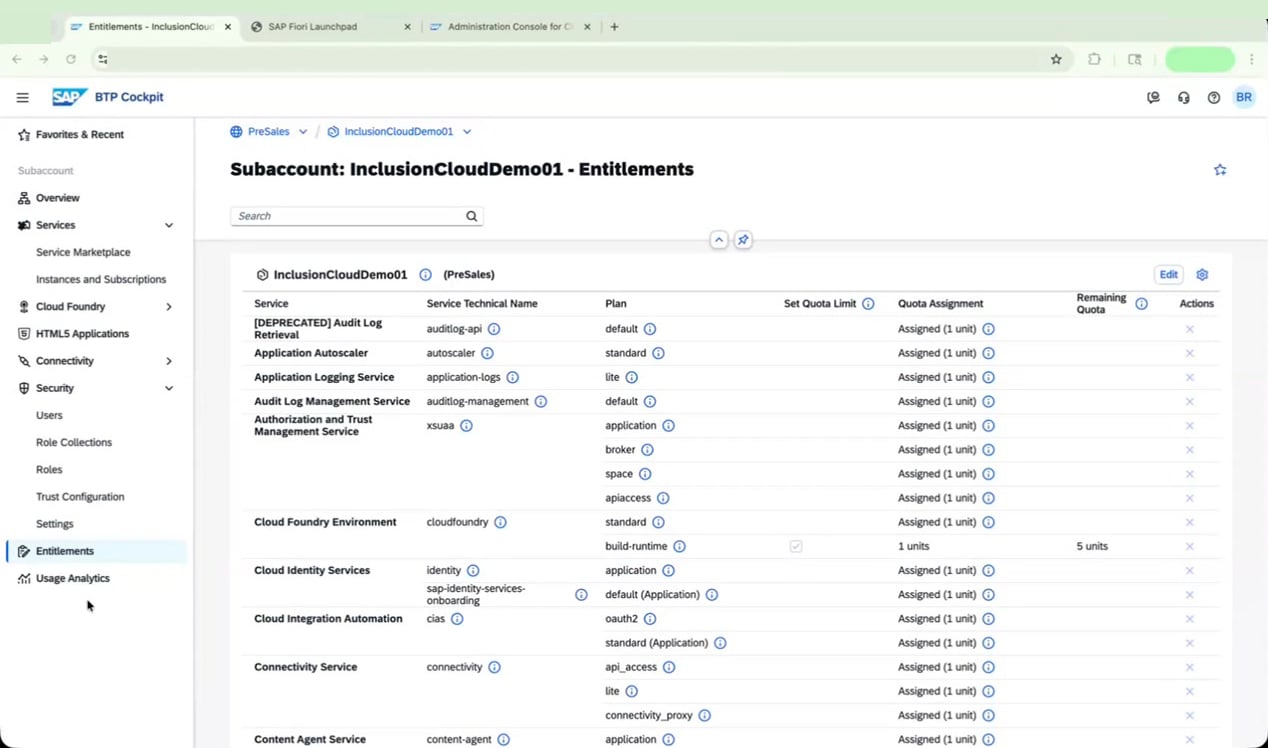
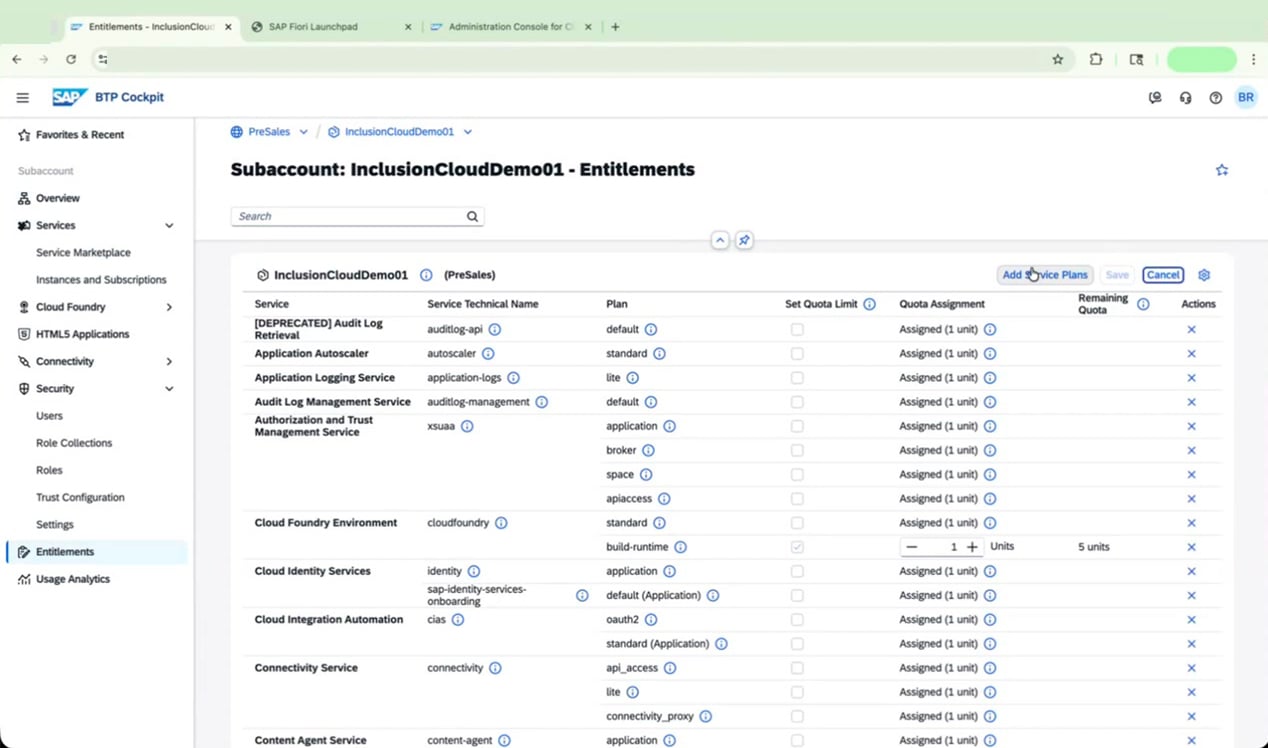
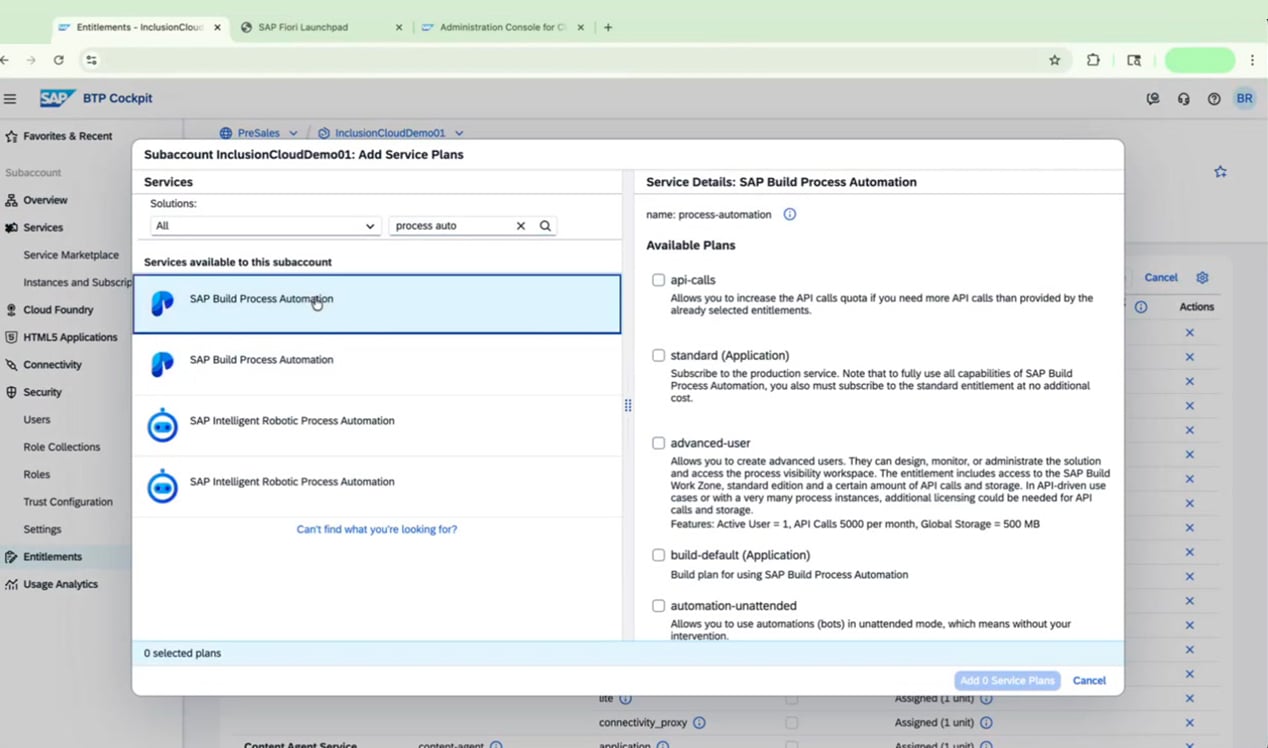
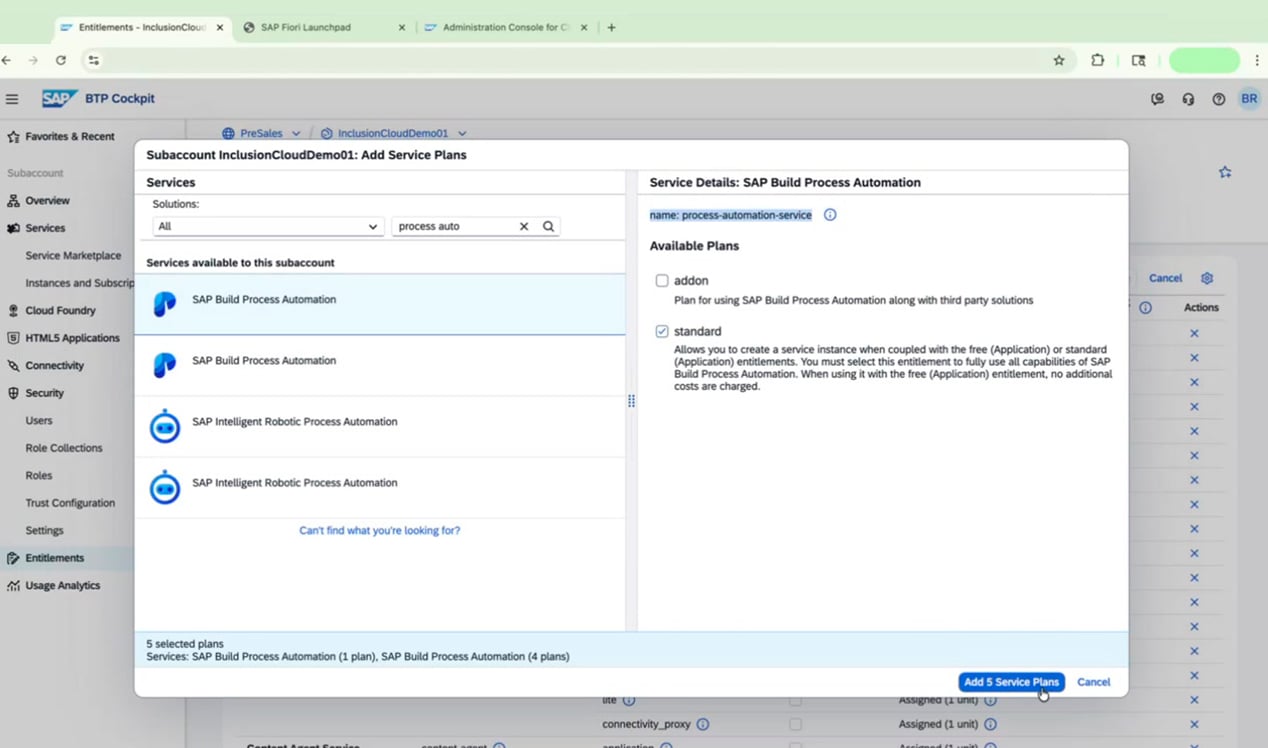
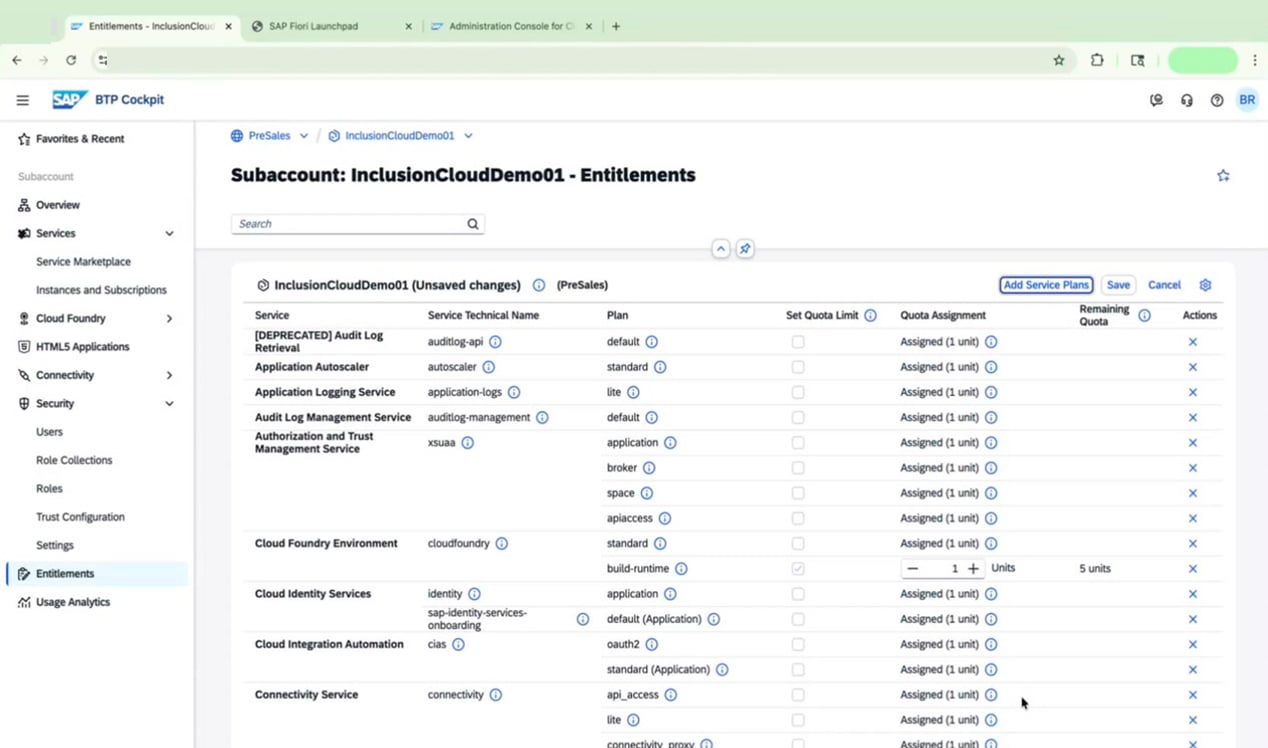
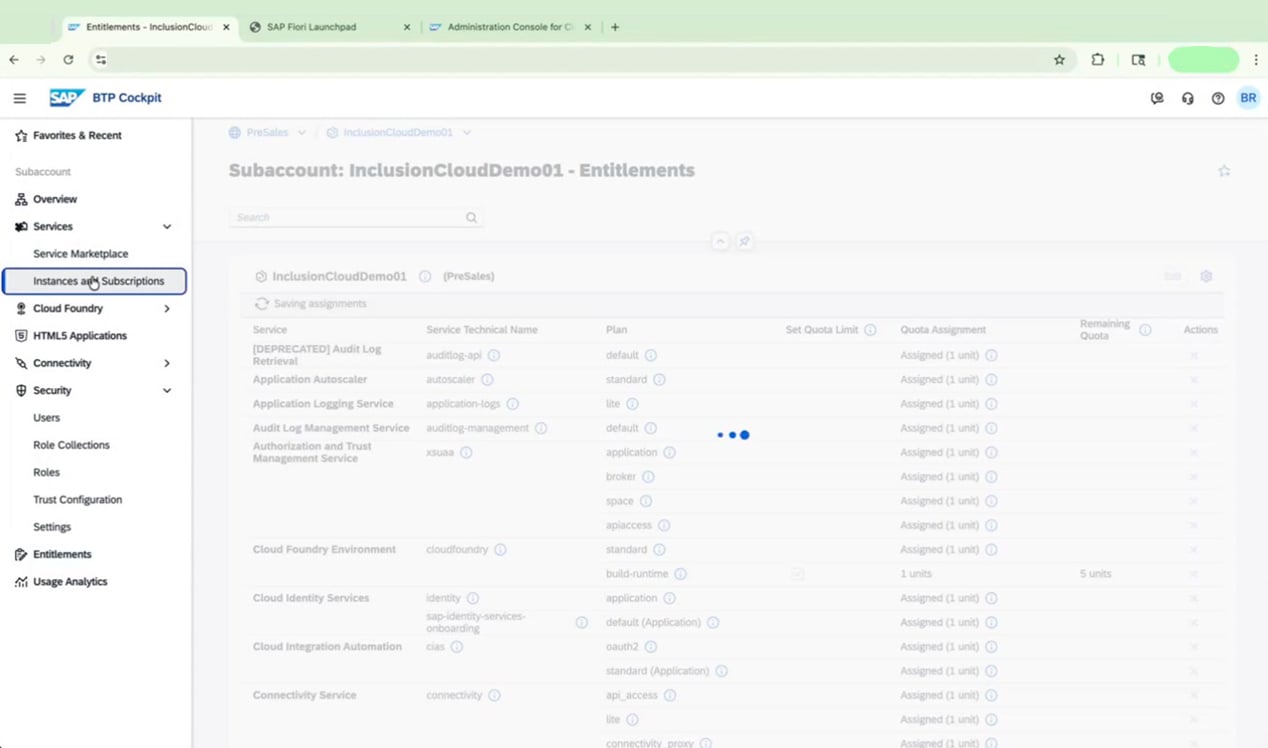
Before you can use SAP Build Process Automation, you need to add the required service plans as entitlements to your subaccount. Step 1: Open the SAP BTP Cockpit and select your subaccount (e.g., InclusionCloudDemo01). In the left sidebar, click Entitlements. Entitlements page for the InclusionCloudDemo01 subaccount Step 2: Click Edit, then click Add Service Plans. Add Service Plans button highlighted on the Entitlements page Step 3: In the Add Service Plans dialog, type process auto in the search bar and select SAP Build Process Automation from the results. Add Service Plans dialog with SAP Build Process Automation selected Step 4: Select all five of the following plans:
PlanPurpose
standardMain service plan
build-default (Application)Build plan for the application subscription
automation-attendedRun bots in attended mode
automation-unattendedRun bots in unattended mode
advanced-userAccess to process visibility workspace
Five plans selected for SAP Build Process Automation Step 5: Click Add 5 Service Plans, then click Save on the Entitlements page to apply the changes. Entitlements page with unsaved changes and the Save button visible
Tip: You can return to the Add Service Plans dialog at any time to add additional plans, such as storage, standard-user, api-calls, or addon (for UiPath connectivity), depending on your requirements.

Procedure 2: Creating the service instance and application subscription

With entitlements in place, you can now create both a service instance and an application subscription for SAP Build Process Automation. Step 1: In the left sidebar, click Instances and Subscriptions. Instances and Subscriptions highlighted in the sidebar Step 2: Click Create. In the New Instance or Subscription dialog, select SAP Build Process Automation as the service and standard as the plan. Fill in the remaining fields as follows:
  • Runtime Environment: Cloud Foundry
  • Space: Dev
  • Instance Name: SAP Build Process Automation
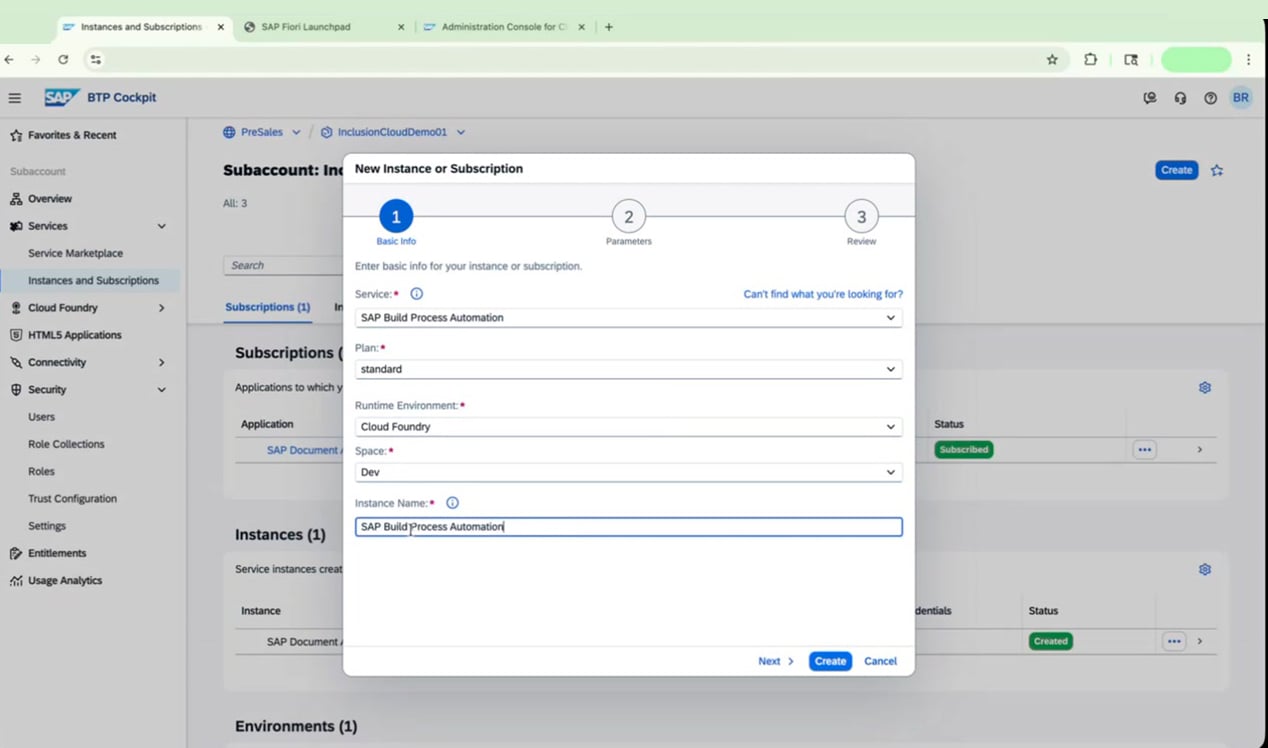
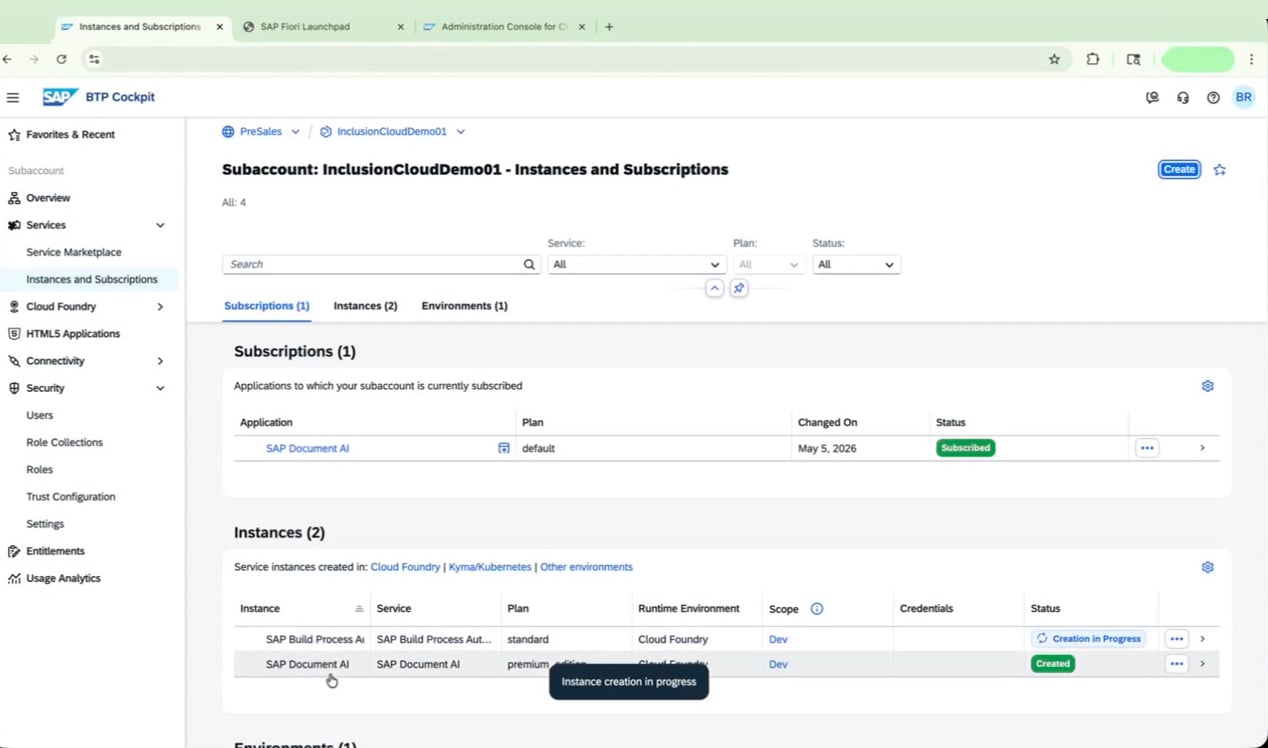
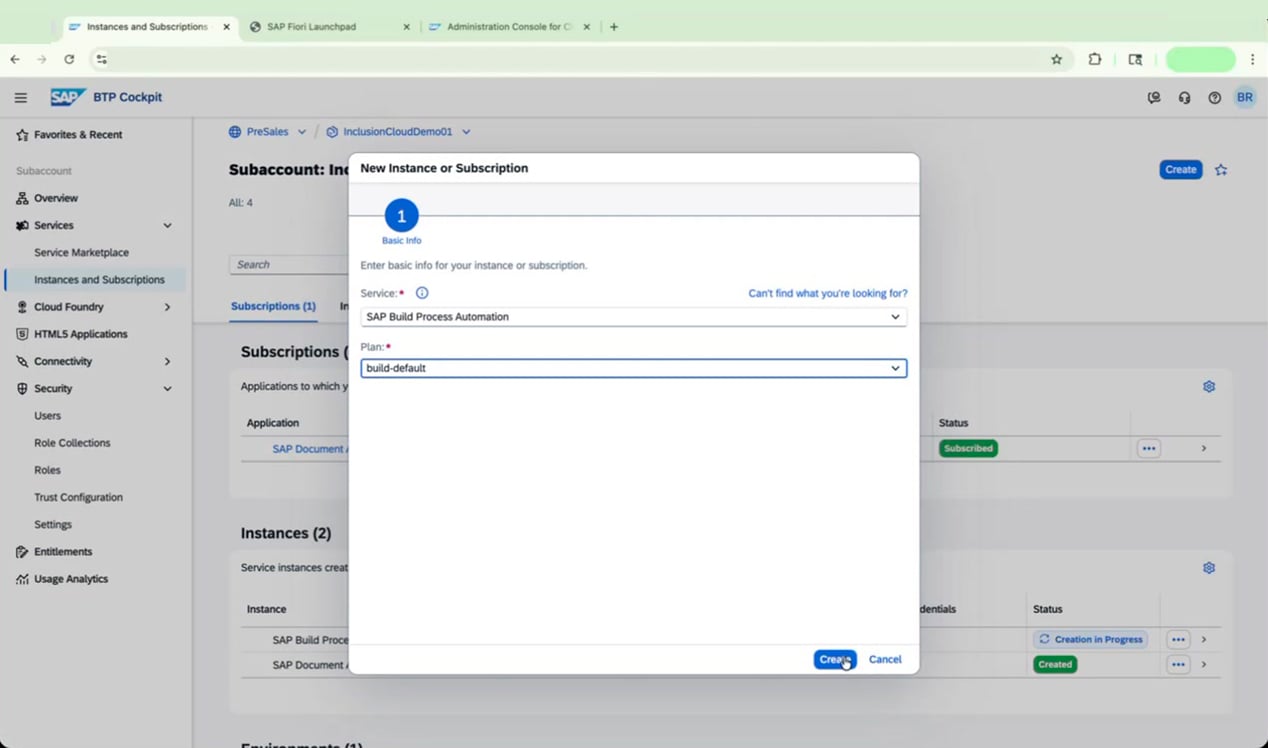
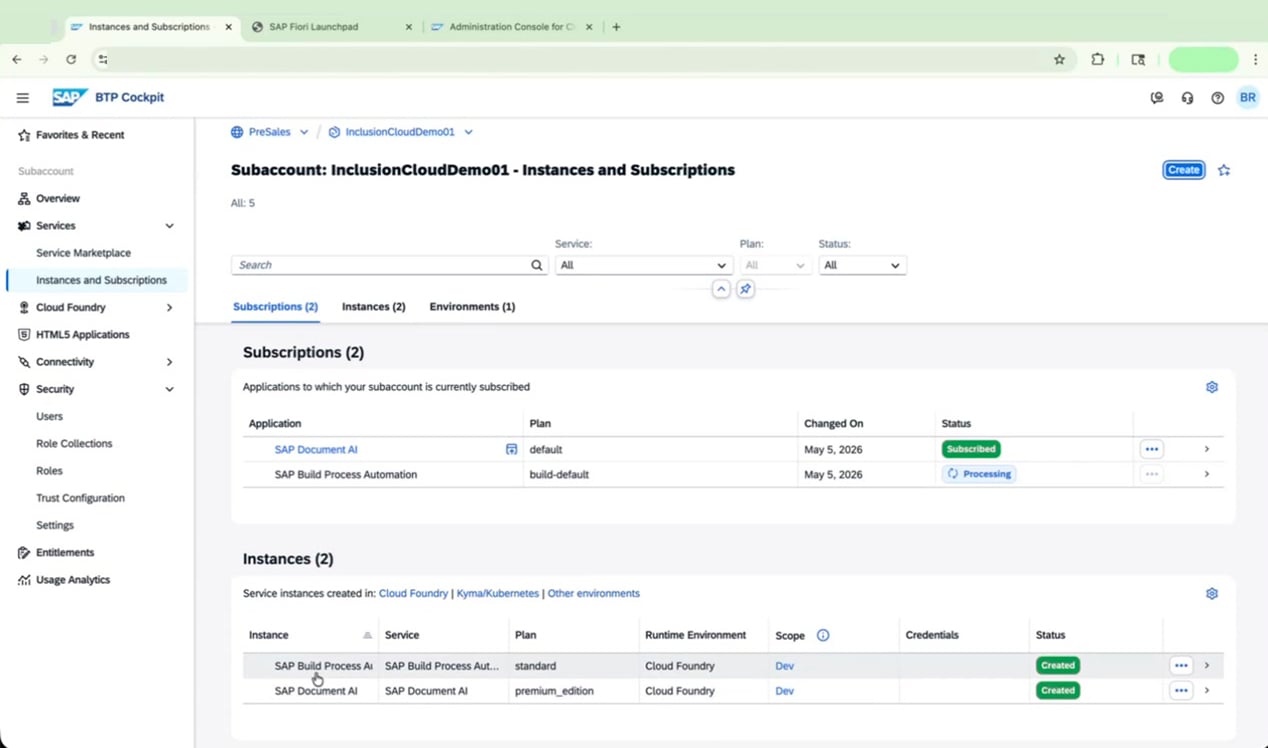
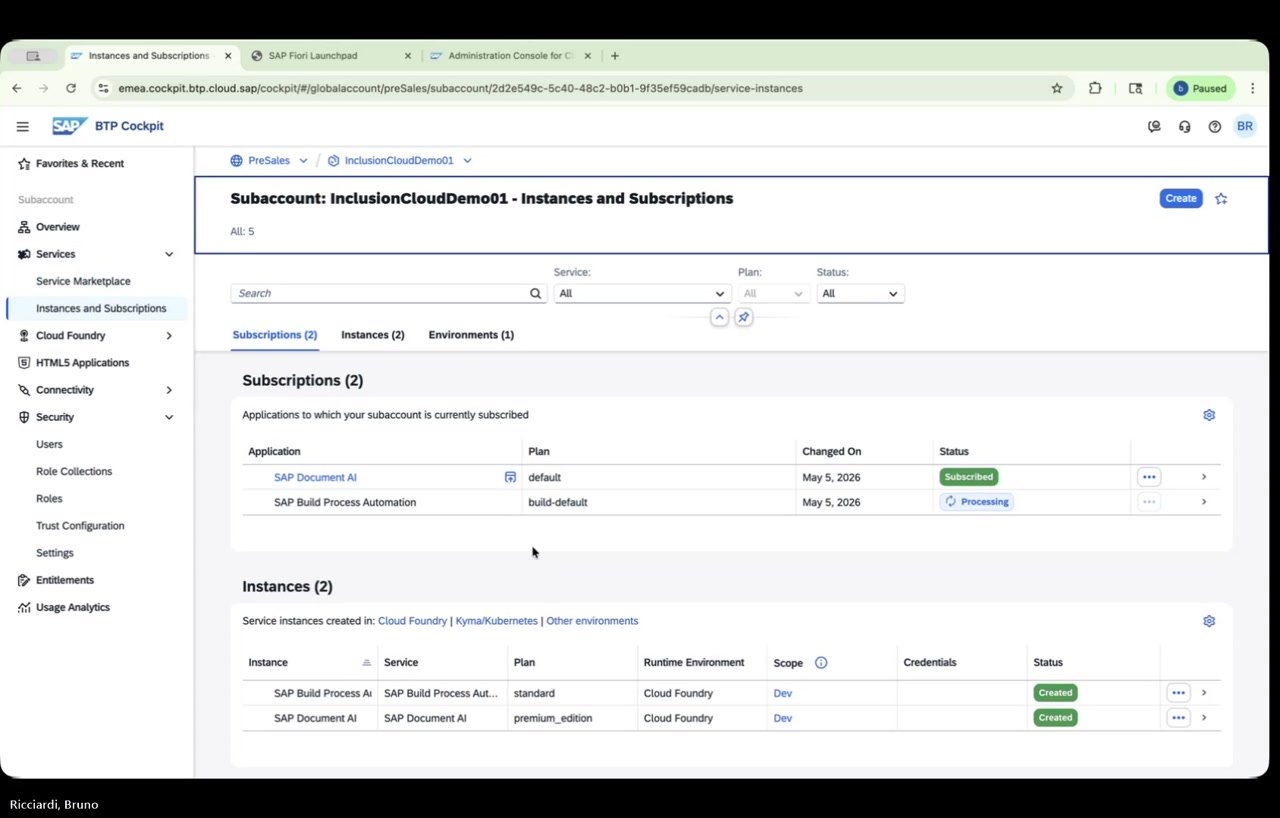
Click Create. Instance creation dialog with all fields filled in Step 3: The new instance appears in the Instances section with a status of Creation in Progress. Wait for it to change to Created before continuing. Instances and Subscriptions page showing the new instance with "Creation in Progress" status Step 4: While the instance is being created, click Create again to set up the application subscription. This time, select SAP Build Process Automation as the service and build-default as the plan, then click Create. New Instance or Subscription dialog with build-default plan selected Step 5: The subscription appears in the Subscriptions section with a status of Processing. The deployment may take several minutes. Subscriptions section showing SAP Build Process Automation with Processing status
Note: If the status does not appear to be updating, navigate away from the Instances and Subscriptions page and return to refresh it. Do not proceed to the next procedure until the subscription status shows Subscribed.
Note: In typical scenarios, you may activate SAP Build Apps first and then activate Process Automation. This guide covers standalone Process Automation activation, which is also a valid configuration.

Procedure 3: Verifying entitlements, instances, and subscriptions

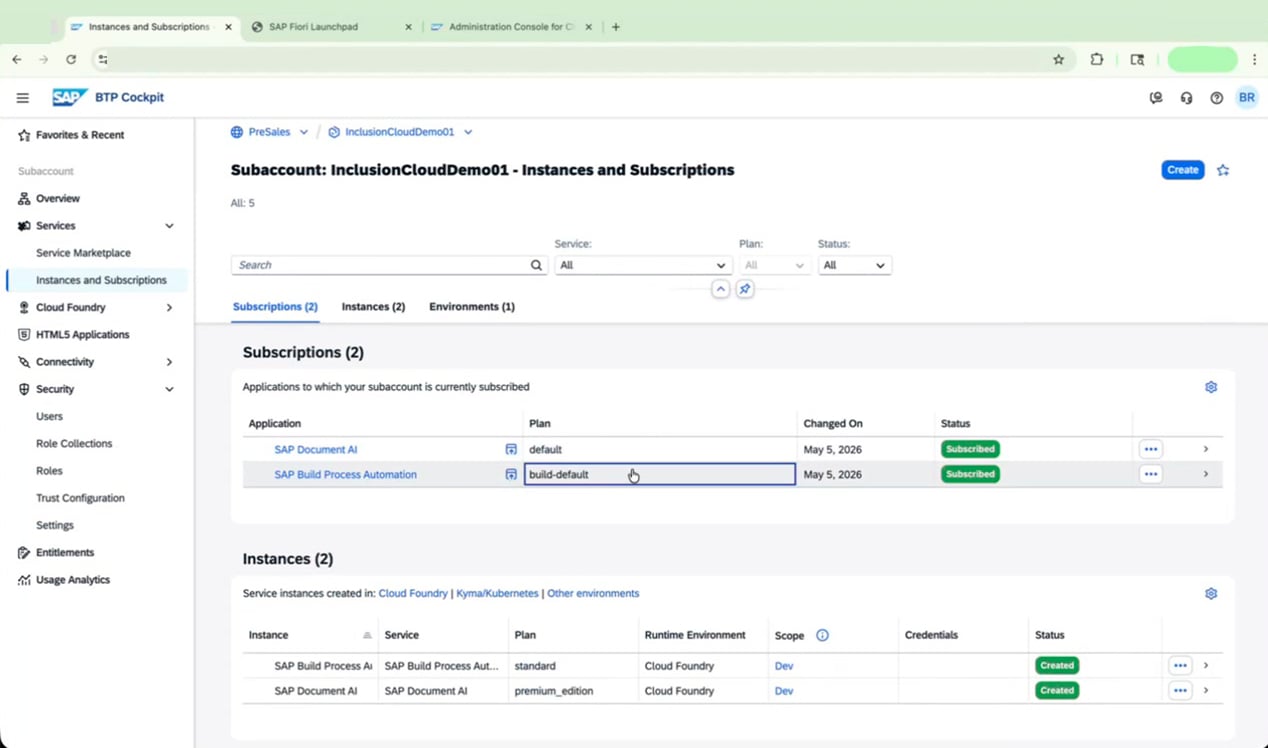
Once provisioning is complete, take a moment to confirm everything is correctly configured before assigning roles. Step 1: Go to Instances and Subscriptions and verify the Subscriptions section. You should see:
ApplicationPlanStatus
SAP Build Process Automationbuild-defaultSubscribed
SAP Document AIdefaultSubscribed
Step 2: In the Instances section, verify the following:
InstanceServicePlanRuntimeSpaceStatus
SAP Build Process AutomationSAP Build Process AutomationstandardCloud FoundryDevCreated
SAP Document AISAP Document AIpremium_editionCloud FoundryDevCreated
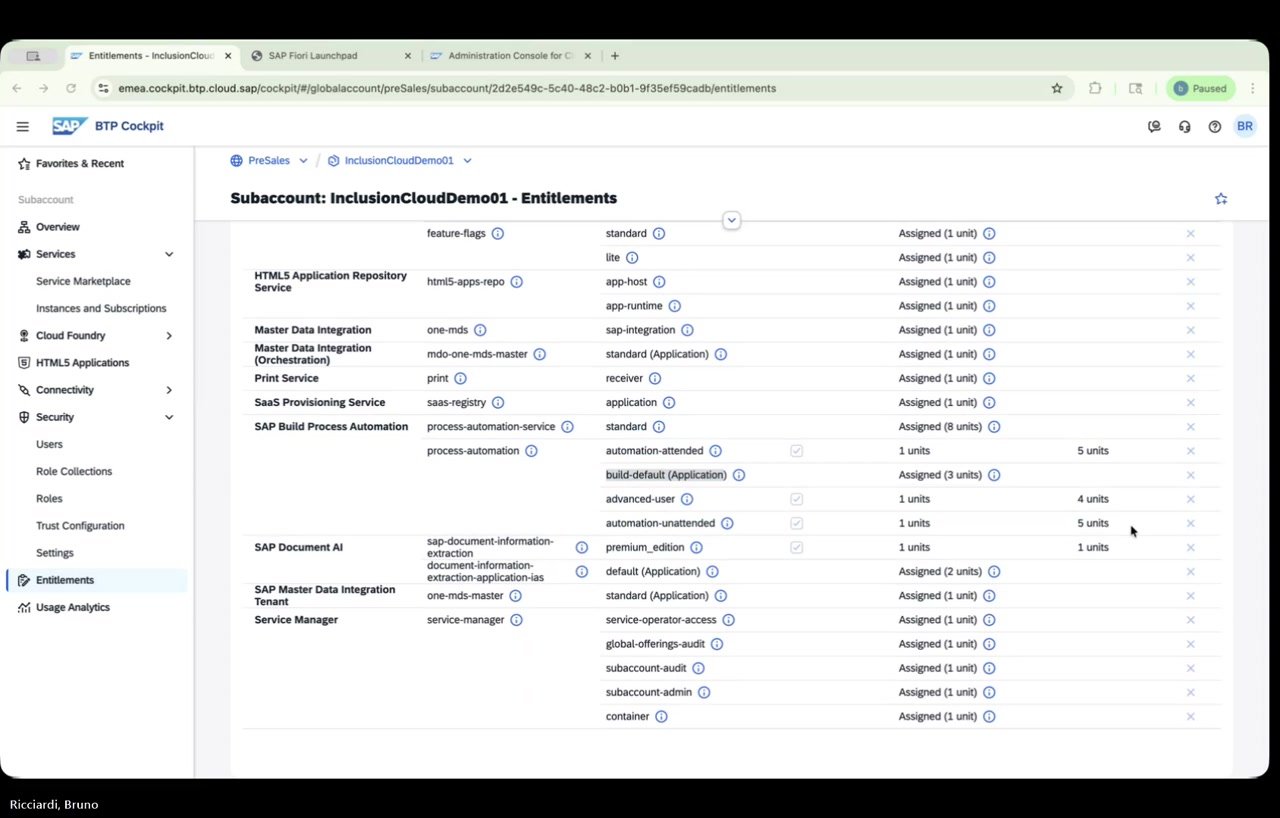
Instances and Subscriptions overview showing all services and statuses Step 3: Navigate to Entitlements and confirm the SAP Build Process Automation plans are listed with their assigned quotas:
PlanAssigned
automation-attended1 unit
build-default (Application)3 units
advanced-user1 unit
automation-unattended1 unit
Entitlements page showing SAP Build Process Automation quotas You’re now ready to assign roles to your business users.

Procedure 4: Assigning role collections to a business user

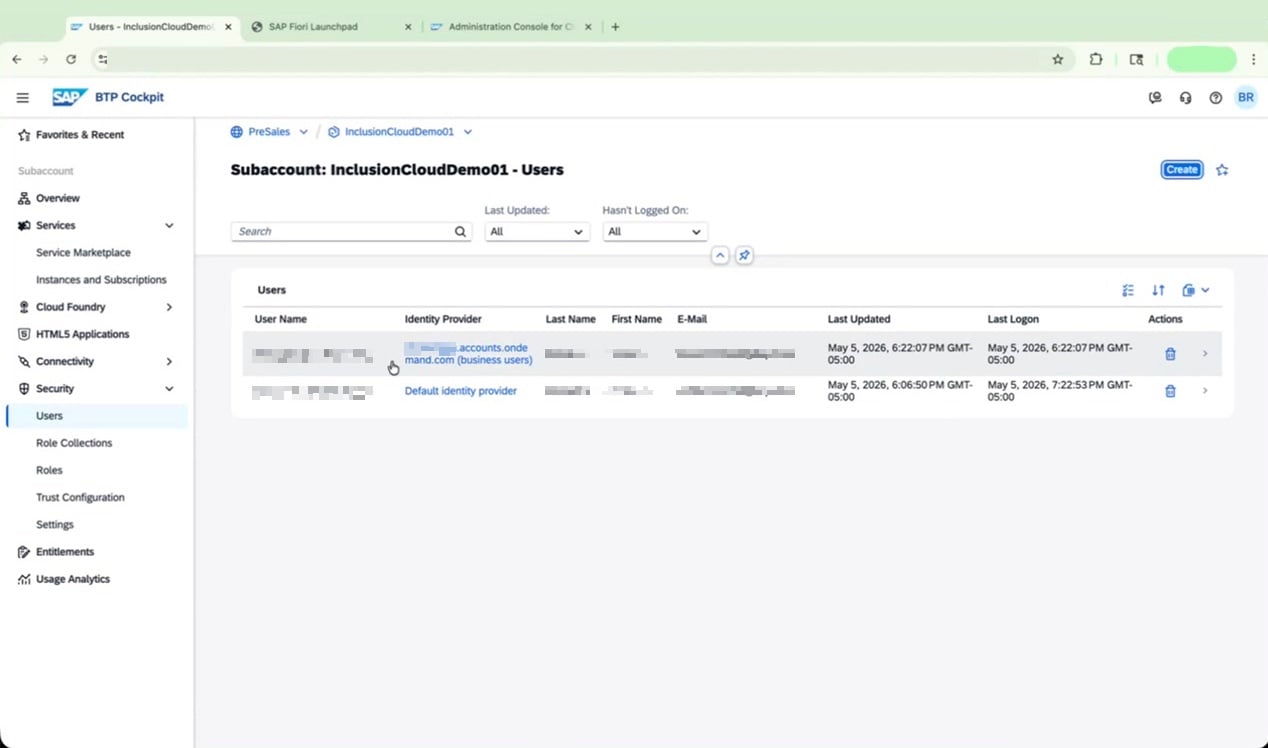
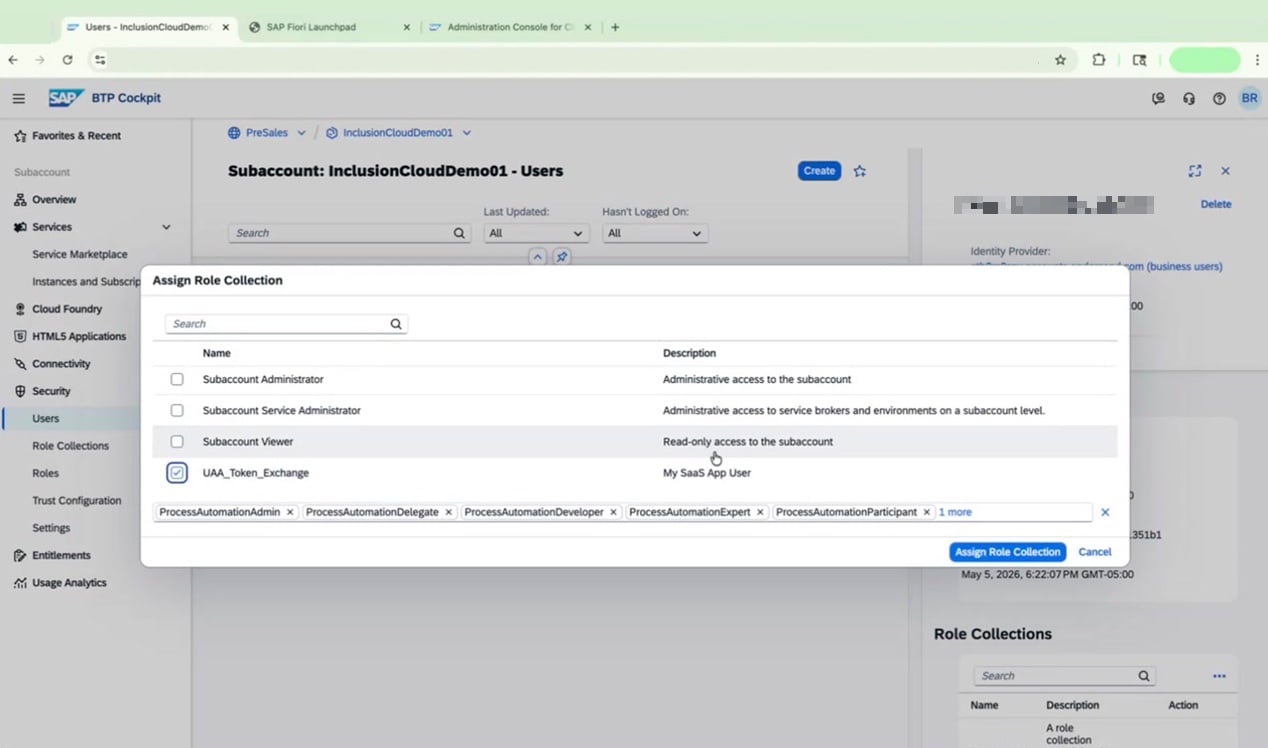
Users need specific role collections assigned before they can access SAP Build Process Automation. Step 1: In the SAP BTP Cockpit, confirm that the SAP Build Process Automation subscription shows the status Subscribed. Subscriptions and Instances page with Subscribed status confirmed Step 2: Go to Security > Users in the left navigation pane. Identify the business user you want to grant access to. Users screen showing business user accounts and identity providers Step 3: Select the user, then click to assign a role collection. In the Assign Role Collection dialog, select all relevant role collections:
  • ProcessAutomationAdmin
  • ProcessAutomationDelegate
  • ProcessAutomationDeveloper
  • ProcessAutomationExpert
  • ProcessAutomationParticipant
  • UAA_Token_Exchange
Click Assign Role Collection to apply. Assign Role Collection dialog with all Process Automation roles selected

Procedure 5: Accessing SAP Build Process Automation and installing the agent

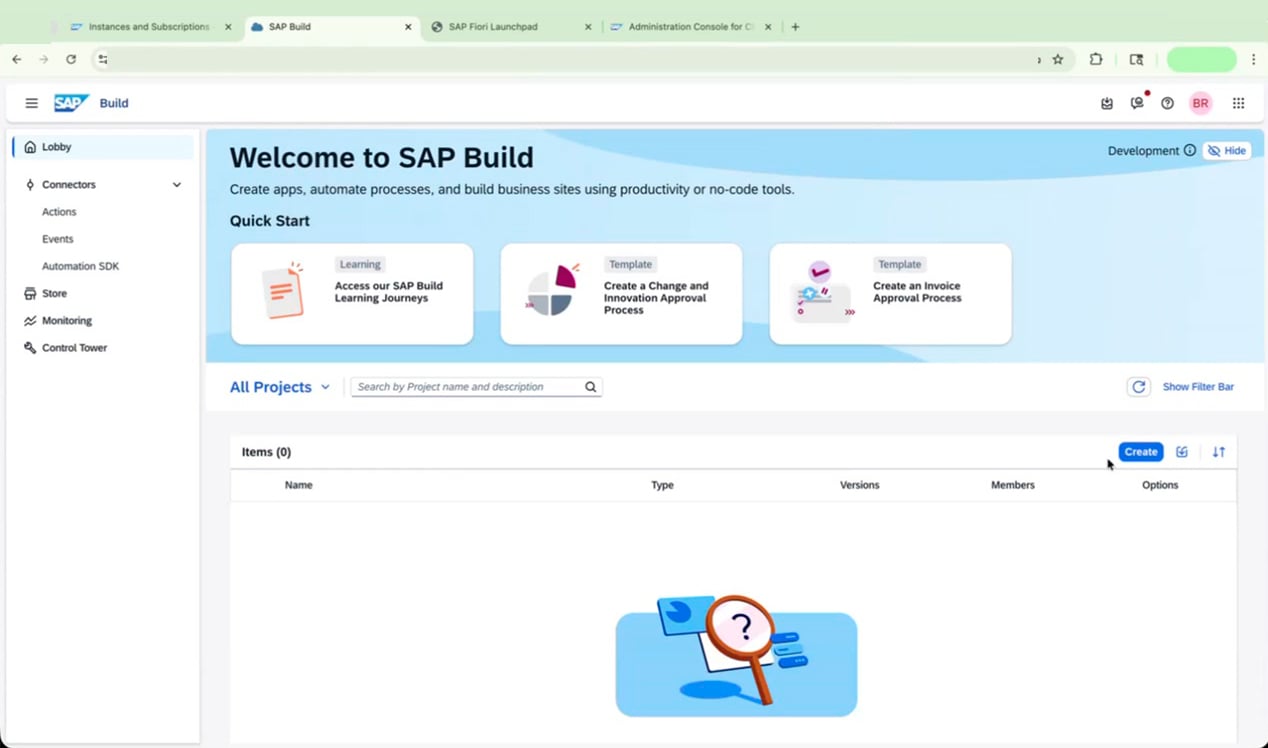
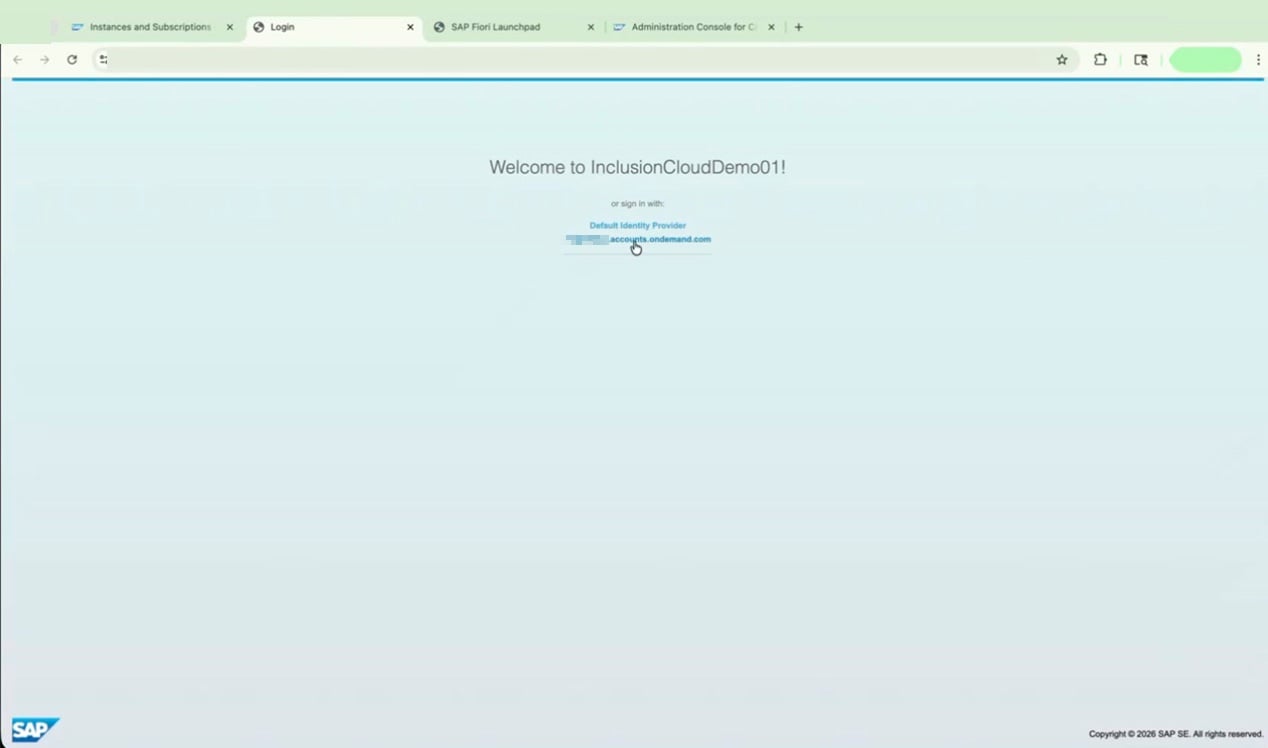
With roles assigned, you can now open the SAP Build Process Automation application and set up the automation agent. Step 1: Go to Instances and Subscriptions and click on the SAP Build Process Automation subscription to open the application. Step 2: When prompted, select your identity provider and sign in with your credentials. Identity provider selection screen Step 3: Wait for the SAP Build lobby to load. Once it appears, you can click Create to start a new project. Available project types include:
  • Application
  • Automated Process
  • Joule Agent and Skill (if subscribed)
  • Business Site (if subscribed)
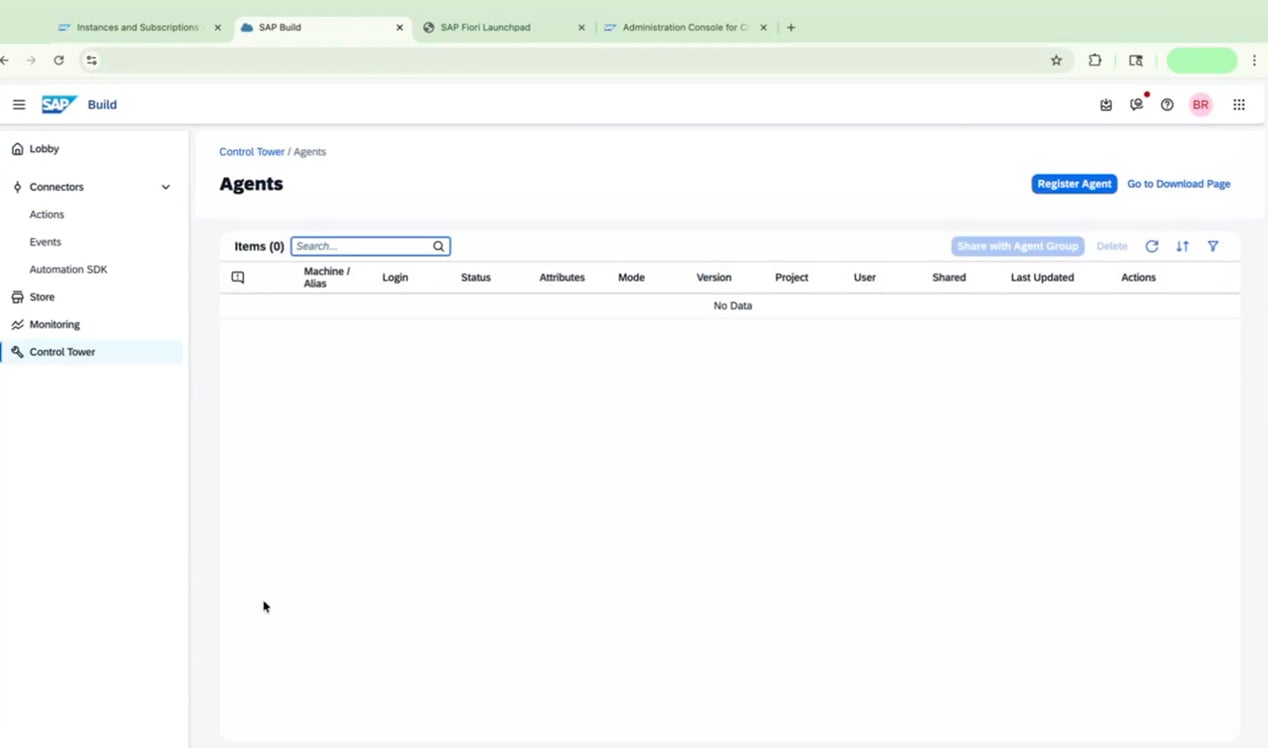
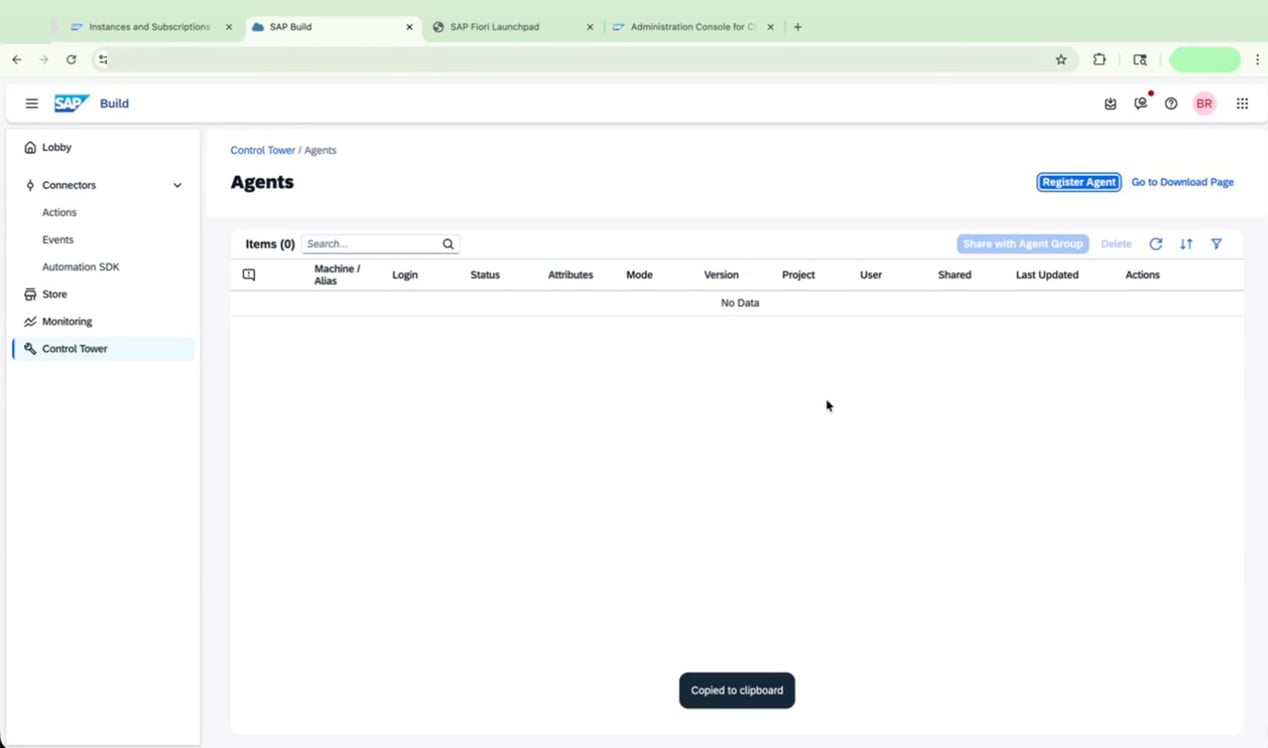
SAP Build lobby with project creation options Step 4: To install the automation agent, navigate to Control Tower in the left navigation pane, then select Agents. Control Tower Agents page with Register Agent option Step 5: Click Go to Download Page and follow the three-step process:
  1. Install the agent — Download and run the installer for your operating system.
  2. Allow the extension — Enable the required browser extension and restart your browser.
  3. Register — Register the agent to your SAP Build Process Automation tenant.
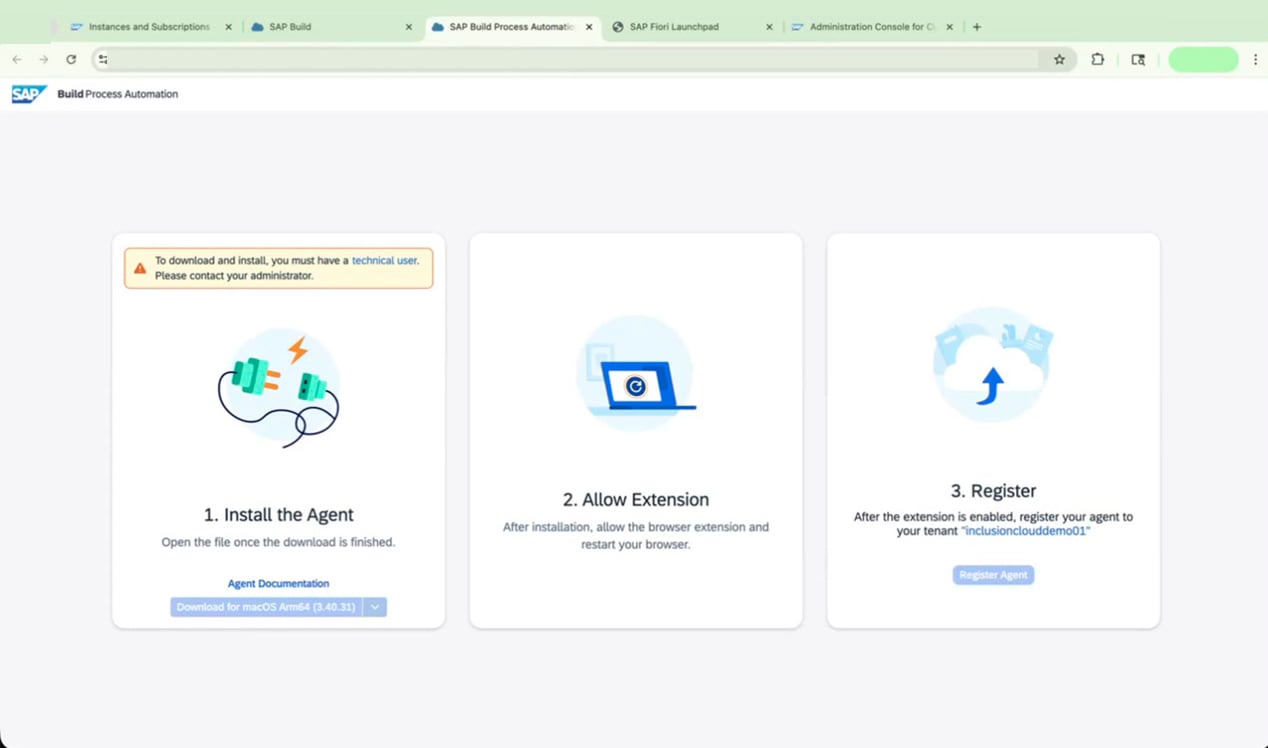
Agent download page showing three installation steps
Note: A technical user account is required to complete agent registration. Contact your administrator if you do not have one.
Step 6: After registration, return to Control Tower > Agents and confirm that your agent appears in the list. Control Tower Agents screen showing the registered agent list

Procedure 6: Activating Generative AI capabilities

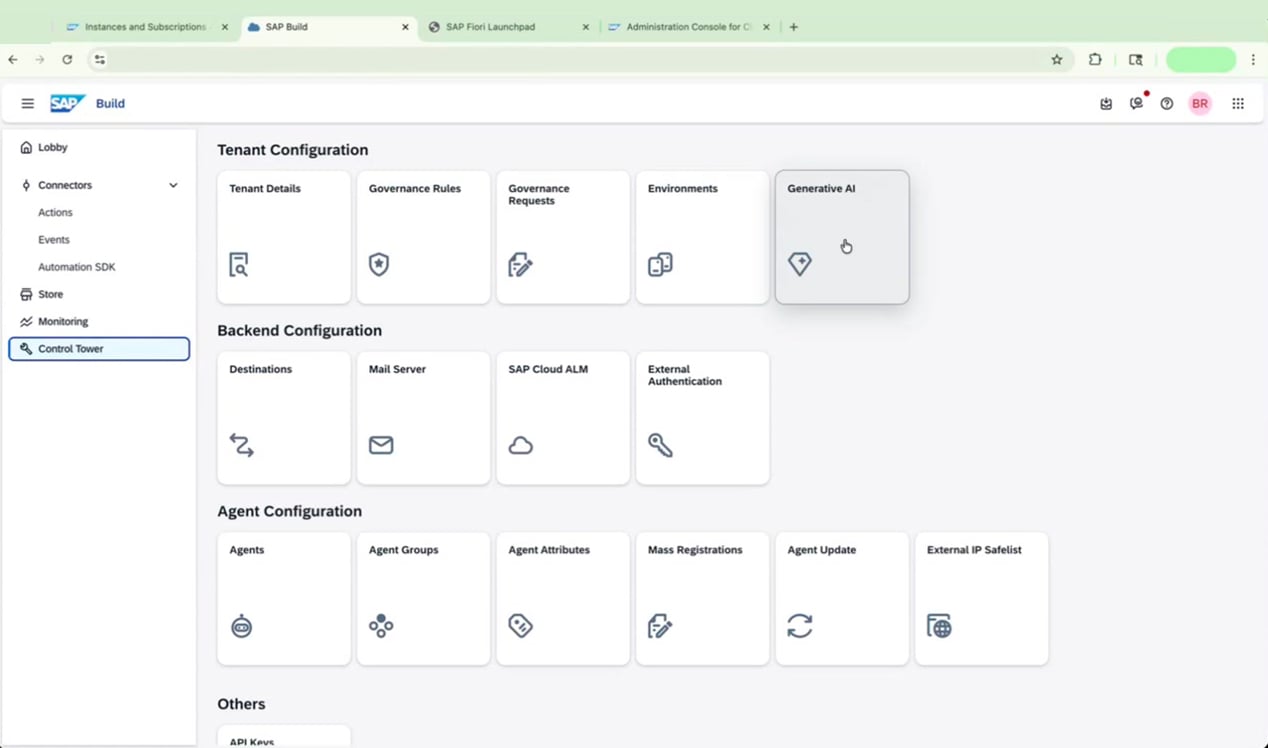
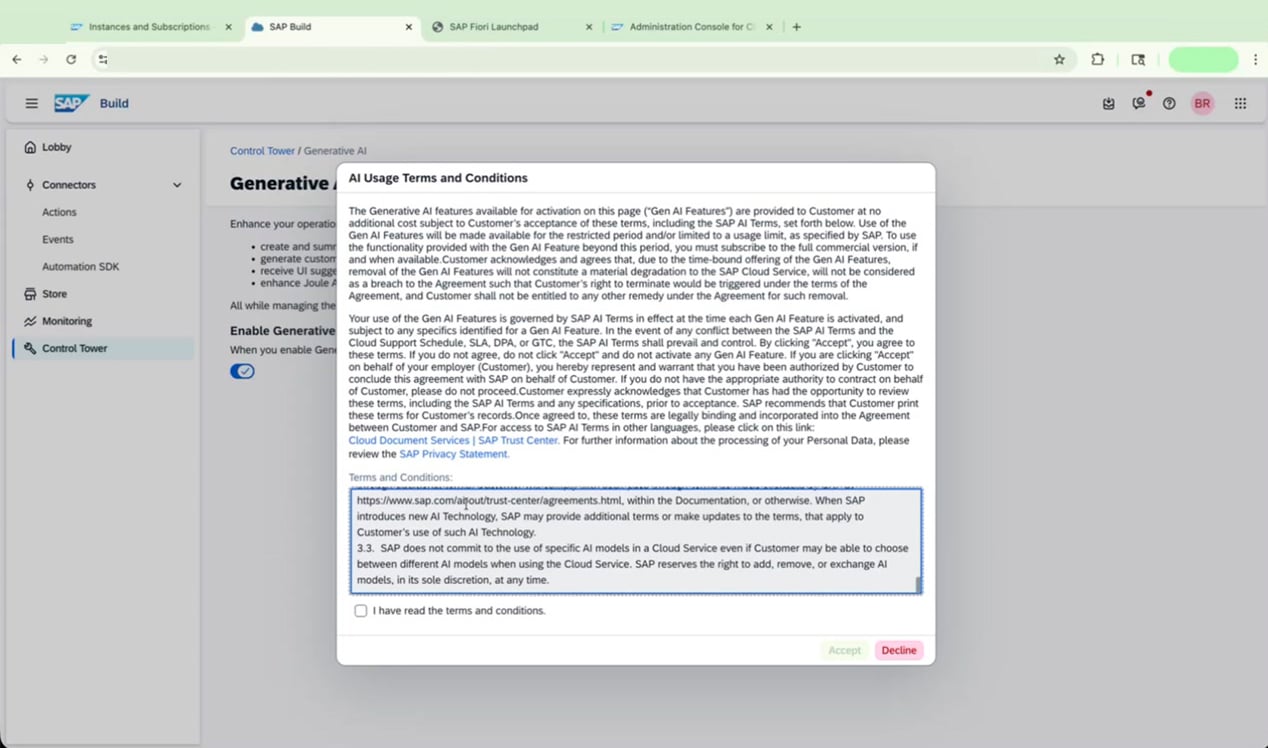
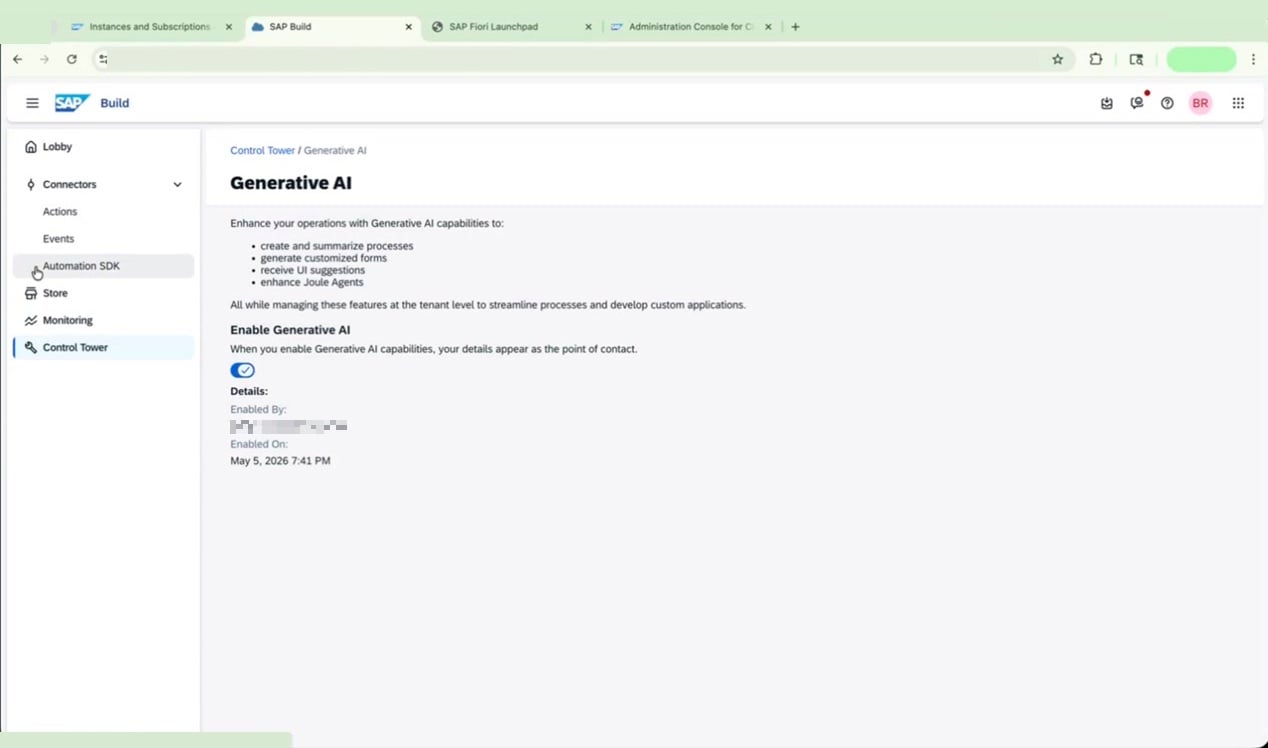
SAP Build Process Automation includes optional Generative AI features that you can enable from the Control Tower. Step 1: In the SAP Build Control Tower, locate the Tenant Configuration section and click the Generative AI tile. Control Tower Tenant Configuration with the Generative AI tile highlighted Step 2: In the AI Usage Terms and Conditions dialog, review the terms, check the I have read the terms and conditions box, then click Accept. AI Usage Terms and Conditions dialog with Accept button Step 3: Confirm that the Enable Generative AI toggle is switched on. The page displays the activating user and the activation date and time. Generative AI configuration screen showing enabled status and activation details Once enabled, Generative AI capabilities are available across your tenant, including:
  • Creating and summarizing processes
  • Generating customized forms
  • Receiving UI suggestions
  • Enhancing Joule Agents
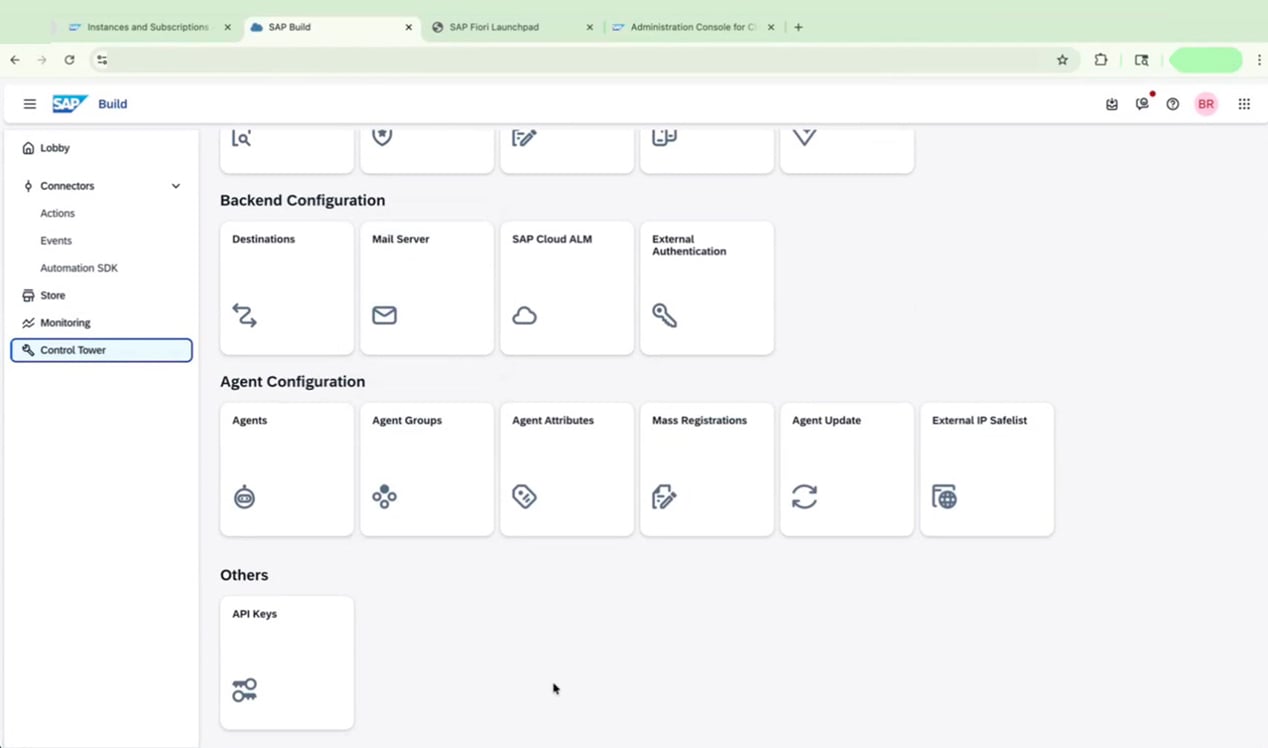
You can also explore additional configuration options in the Control Tower, such as Destinations, Mail Server, SAP Cloud ALM, External Authentication, Agent Groups, API Keys, and more. Control Tower configuration overview showing all available tiles

Conclusion

You have now fully configured SAP Build Process Automation in your SAP BTP environment. You added the required entitlements, provisioned a service instance and application subscription, verified all statuses, assigned role collections to a business user, installed and registered the automation agent, and activated Generative AI capabilities. Your environment is ready to start building and running automated processes.

FAQ

How long does the subscription deployment take? The status moves from Processing to Subscribed within a few minutes, but may take longer depending on system load. Navigate away and return to refresh the status if it appears stuck. Do I need to assign all six role collections to every user? No — assign only the role collections that match each user’s responsibilities. For example, a developer would need ProcessAutomationDeveloper, while an end user who only triggers processes would need ProcessAutomationParticipant. What is the difference between the standard plan and the build-default plan? The standard plan is used to create a service instance (for API-level access via Cloud Foundry). The build-default plan is used to create the application subscription that provides access to the SAP Build Process Automation web interface. Is a technical user required for agent installation? Yes. A technical user account is required to register the agent to your tenant. Contact your SAP BTP administrator if you do not have one. Can I add more entitlement plans later? Yes. You can return to Entitlements > Edit > Add Service Plans at any time to add additional plans such as storage, standard-user, or api-calls.